



The strategic landscape of Eastern Europe has entered a new and deeply unsettling phase, as evidenced by the joint nuclear drills conducted by Russia and Belarus. These exercises, announced by authorities on a recent Monday, represent more than a routine military activity; they are a stark manifestation of the escalating standoff between Moscow and the NATO alliance, set against the crumbling framework of international arms control. With the final major treaty limiting U.S. and Russian nuclear arsenals, New START, having expired in February 2026, the world’s two largest nuclear powers now operate without the mutual constraints that provided a measure of predictability for over a decade. This drill, therefore, is not conducted in a vacuum but within a perilous political void, where rhetorical posturing carries the grave weight of nuclear implication. The deployment of advanced systems like the Oreshnik hypersonic missile to Belarusian territory in the preceding year has already raised the stakes, physically positioning weapons capable of evading modern defenses at NATO’s doorstep and fundamentally altering the regional security calculus.
According to the Belarusian defense ministry, the exercise focused on practicing the delivery of nuclear munitions and their preparation for use in coordination with Russian forces. While the ministry’s statement insisted the training was “not directed against third countries,” such assurances ring hollow against a backdrop of sustained aggression and nuclear saber-rattling. For nations in the region, particularly Ukraine and NATO’s eastern flank members, the spectacle of two allied regimes rehearsing nuclear operations is inherently threatening. The participation of aviation and missile forces underscores the integrated nature of this strategic partnership, moving beyond symbolic solidarity to active, operational collaboration. This fusion of capabilities effectively extends Russia’s nuclear umbrella—and its potential launch platforms—deeper into Europe, challenging the post-Cold War security order and forcing a recalibration of defense postures from the Baltic to the Black Sea.
The immediate and most acute apprehension generated by these drills is felt in Ukraine. President Volodymyr Zelenskyy, just days before the nuclear exercises, ordered a reinforcement of Ukraine’s northern border with Belarus. He warned that Moscow, facing a protracted and costly war, is seeking to draw its ally more directly into the conflict and is plotting new offensive operations from Belarusian territory. Zelenskyy outlined two potential axes of threat: a renewed push towards the Ukrainian capital regions of Chernihiv and Kyiv, or even a provocative operation against a NATO member state. These concerns are not speculative but are rooted in recent history; Belarus served as a crucial staging ground for the initial, full-scale invasion in 2022. The Kremlin swiftly dismissed these allegations as “an attempt at further incitement,” yet the simultaneous conduct of nuclear drills only amplifies Ukrainian anxieties, creating a pincer of conventional and nuclear intimidation aimed at draining Ukrainian resolve and resources.
Behind this alarming military activity lies the calculated strategy of Russian President Vladimir Putin. As his conventional military campaign has encountered significant setbacks and stalemates, the invocation of nuclear capabilities has become a recurrent tool in his geopolitical arsenal. The testing of the Sarmat intercontinental ballistic missile shortly before these drills serves as a complementary act of demonstration, a reminder of Russia’s vast strategic reach. This rhetoric and activity are designed to achieve multiple objectives: to deter NATO from escalating its support for Ukraine, to sow division within the Western alliance by evoking fears of direct confrontation, and to mask strategic weaknesses on the battlefield with a show of ultimate strength. It is a perilous game of brinkmanship that seeks to manipulate the West’s inherent risk aversion, using the shadow of nuclear catastrophe as a shield for territorial ambition in Ukraine.
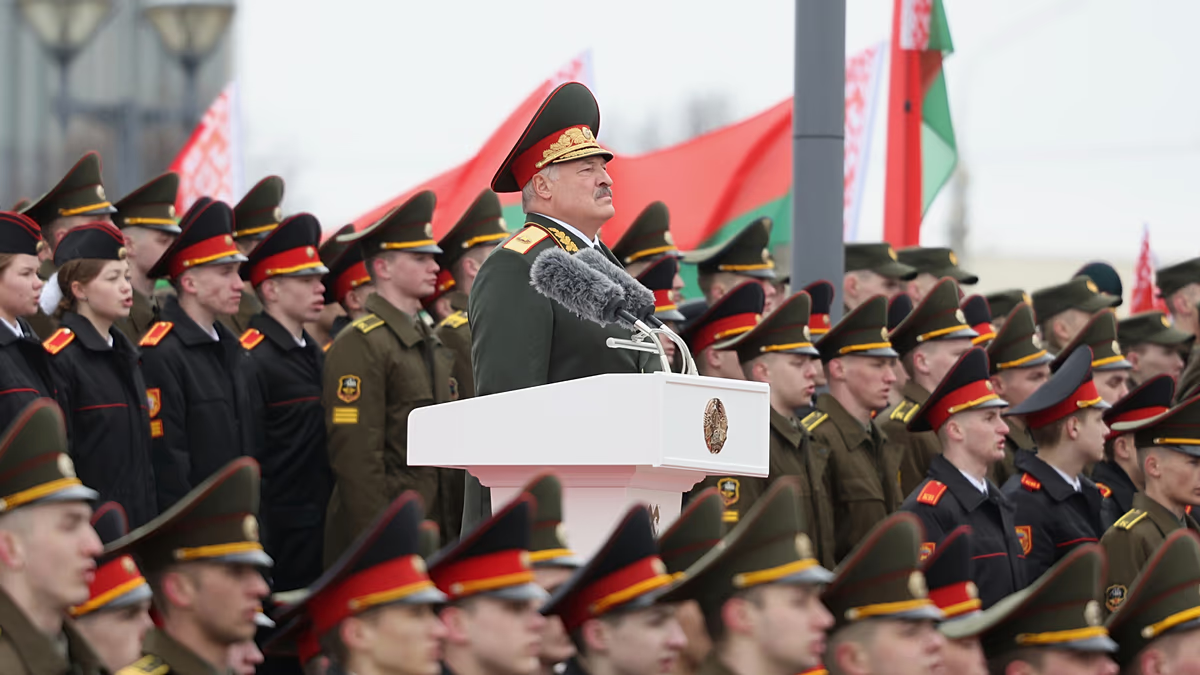
The role of Belarus in this dynamic is one of deepening and seemingly irreversible dependency. Under the three-decade rule of Aliaksandr Lukashenka, the country has increasingly mortgaged its sovereignty to Moscow in exchange for political and economic survival. The stationing of Russian nuclear weapons on its soil marks the culmination of this process, transforming Belarus from a reluctant ally into a forward operating base for Russia’s most fearsome weapons. This arrangement locks Minsk into Moscow’s strategic orbit, making it a potential target in any future conflict and limiting its diplomatic room for maneuver. For Lukashenka, it consolidates his regime’s power with Kremlin backing, but for the Belarusian people, it signifies a future inextricably tied to Russia’s confrontational and isolated path, with all the attendant economic hardships and security perils that entails.
In conclusion, the joint Russia-Belarus nuclear drills are a symptom of a world sliding back toward a dangerous, bipolar tension, but without the guardrails and channels of communication that characterized the Cold War. They highlight the complete erosion of arms control architecture and the deliberate use of nuclear uncertainty as a tactical weapon in a conventional war. For Ukraine, it compounds an already existential fight with an ominous shadow from the north. For NATO, it presents a complex challenge of deterring escalation while sustaining support for Kyiv. And for the international community, it signals a distressing normalization of nuclear threats, where such exercises are becoming a recurring feature of diplomacy by coercion. The path forward requires a steadfast, unified, and sober response from democracies, one that rejects nuclear blackmail while urgently seeking new frameworks for strategic stability, lest the world stumbles from managed competition into unmanageable crisis.