
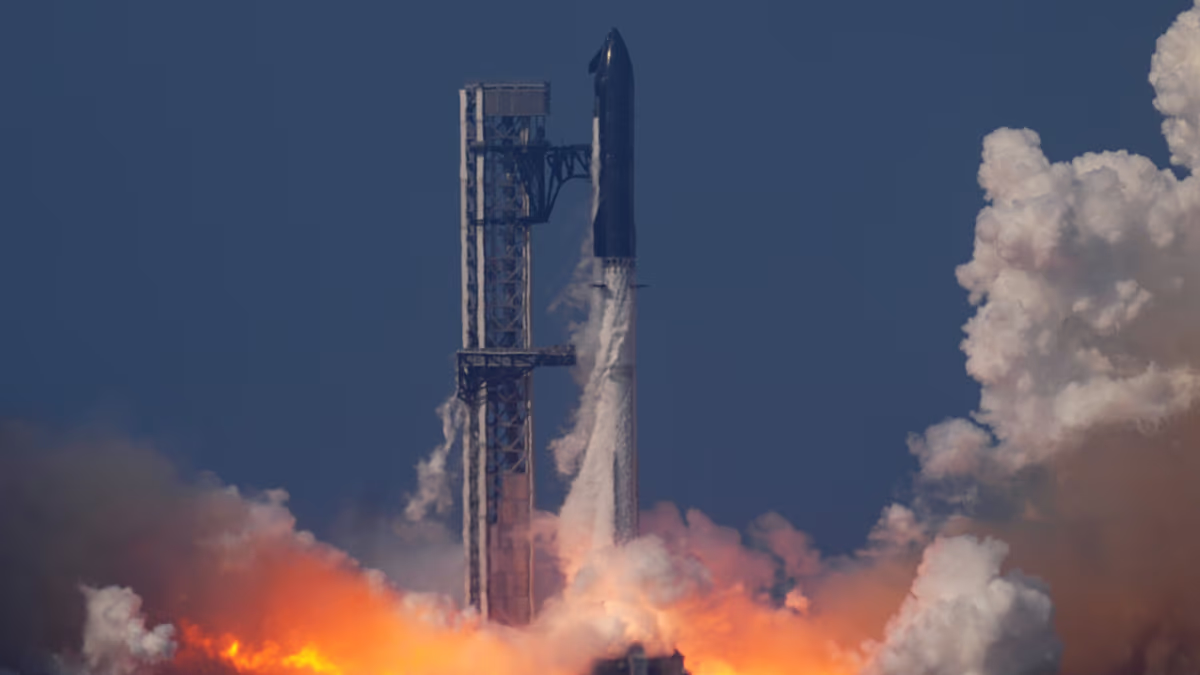



The skies above Starbase, Texas, roared to life on Friday with the thunderous launch of SpaceX’s Starship V3, the latest and most formidable iteration of the world’s most powerful rocket system. This flight, a critical test in the program’s ambitious development, marked another bold step toward realizing SpaceX’s vision of a fully reusable spacecraft capable of carrying humans and cargo to the Moon, Mars, and beyond. Following a one-day delay due to a hydraulic issue on the launch tower, the successful liftoff was met with cheers from gathered crowds, their excitement a testament to the public’s enduring fascination with humanity’s renewed push into the cosmos. The mission was not merely a spectacle, but a complex, high-stakes experiment designed to push the boundaries of current aerospace technology and gather invaluable data under real flight conditions.
The roughly hourlong journey was largely a success, achieving several pivotal objectives that underscore the rocket’s evolving capabilities. Most notably, the mission demonstrated the vehicle’s ability to deploy payloads in space, successfully releasing mock Starlink satellites from its payload bay. This test is a direct precursor to Starship’s intended role as a super-heavy-lift launch vehicle for SpaceX’s massive satellite internet constellation. Furthermore, the flight provided crucial data on the performance of the spacecraft’s heat shield during re-entry—a vital component for any vehicle intending to return safely to Earth from orbital velocities. However, the path to progress is rarely smooth, and this mission was no exception. Both the Super Heavy booster and the Starship upper stage experienced engine failures during their respective phases of flight, a stark reminder of the immense technical challenges involved in orchestrating the synchronized performance of such a complex machine.
The dramatic conclusion of the flight was captured in video footage showing the Starship spacecraft making a controlled descent into the Indian Ocean. In a planned maneuver, the vehicle was intentionally destroyed upon splashdown. SpaceX stated that this controlled demolition was part of the test profile, likely to ensure the vehicle sank in a safe and predictable manner without becoming navigational debris. This “successful failure” paradigm is central to SpaceX’s rapid development strategy. Rather than designing for infallibility from the outset, the company builds, flies, learns from mishaps, and iterates with remarkable speed. Each test, whether it ends in a textbook-perfect landing or a controlled explosion, generates terabytes of data that engineers use to refine designs, improve materials, and upgrade software for the next attempt.
The development of Starship represents a fundamental shift in aerospace philosophy. Its sheer scale is staggering, designed to be entirely reusable—a concept that promises to drastically reduce the cost of accessing space. The V3 test moves this vision incrementally closer to reality. While the engine outages highlight ongoing propulsion challenges, each flight provides deeper insight into the limits and behaviors of the Raptor engines under extreme stress. Similarly, the data from the heat shield during atmospheric re-entry will inform improvements to the thermal protection system, which must withstand temperatures hot enough to melt steel. These are not setbacks but essential lessons, each anomaly a guidepost on the road to reliability.
Beyond the immediate technical takeaways, this launch reinforces SpaceX’s role as a dominant force in shaping the future of space exploration. The successful deployment of test satellites points toward Starship’s near-term utility in expanding global internet connectivity. Its long-term purpose, however, is far grander: to serve as the crewed lander for NASA’s Artemis missions to the Moon and, ultimately, as a vessel for the first human missions to Mars. Every test flight, with its mix of triumphs and tribulations, builds confidence in this audacious timeline. It demonstrates a relentless, action-oriented approach to problem-solving that is accelerating humanity’s return to deep space exploration.
In the end, the flight of Starship V3 was a powerful narrative of human ingenuity and tenacity. The cheers from Texas echoed a collective hope, while the fiery splashes in the Indian Ocean underscored the gritty reality of engineering at the frontier. SpaceX, by openly sharing both its spectacular launches and its explosive learning moments, has demystified the rocket development process. This latest chapter confirms that the journey to making interplanetary travel routine is well underway, propelled not by flawless perfection, but by an unwavering commitment to learn, adapt, and fly again. The path to the stars is being paved one test, one explosion, and one hard-won success at a time.