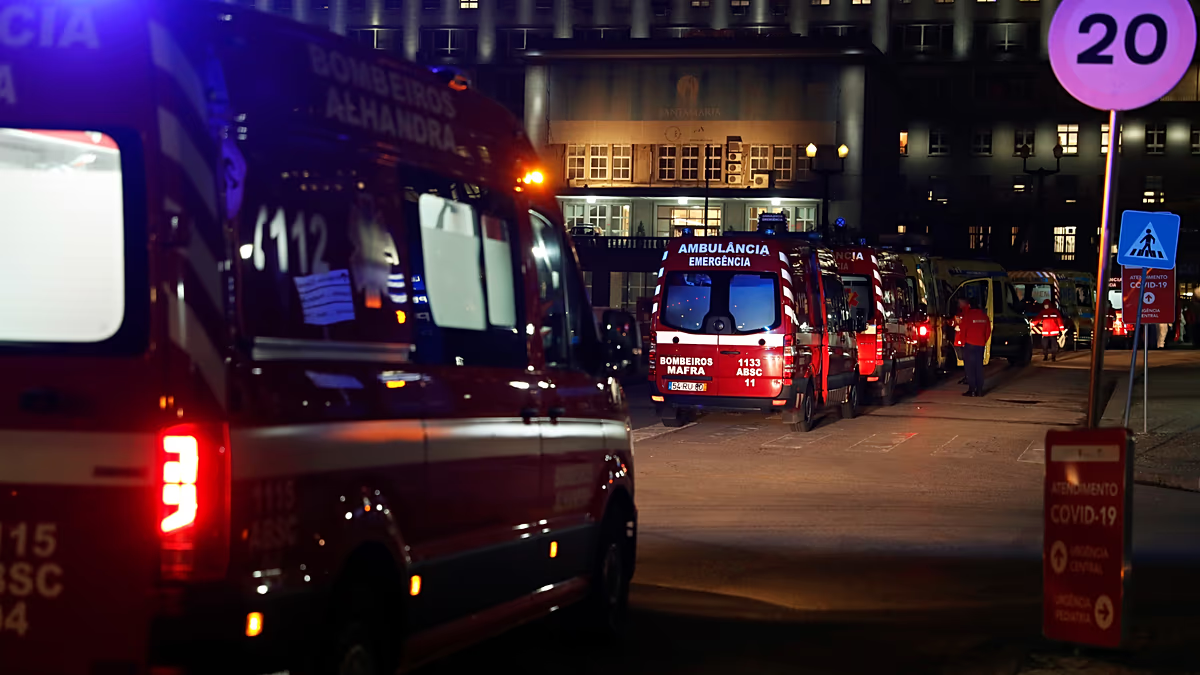



The recent drone incursion into Romanian territory, resulting in an explosion at a residential building in the city of Galați, represents a stark and alarming escalation in the security challenges facing Europe’s eastern flank. This was not a mere stray object but an explosive-laden Russian drone that crashed into an apartment block, injuring two civilians and sparking a fire. The tangible human cost—the shock, the fear, the physical harm—has pierced the abstract notion of spillover from the war in Ukraine, bringing the conflict’s violence directly to a Romanian neighbourhood. In response, the Romanian government took the significant diplomatic step of expelling the Russian consul in Constanța and shutting down the consulate, placing clear blame on Moscow. This incident, marking the first time Romanians have been physically injured by such cross-border events, has shattered any lingering sense of buffer or distance, proving that the frontline is not confined to Ukrainian soil.
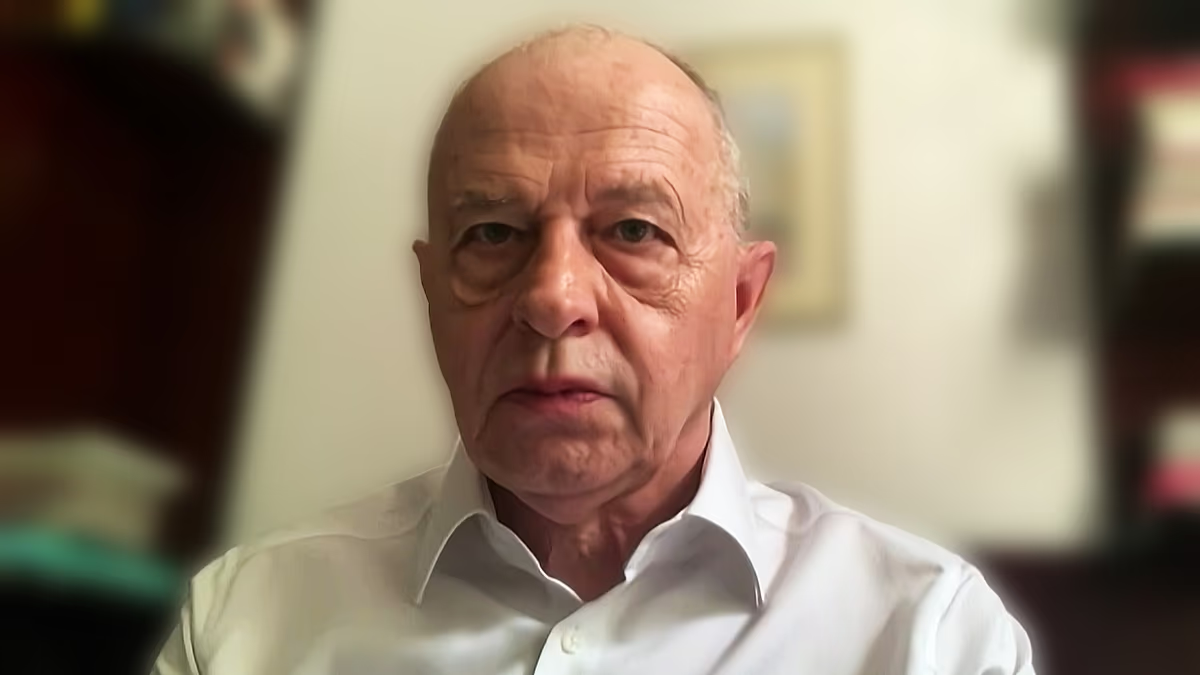
The emotional and geopolitical resonance of this attack is profound, as articulated by former NATO Deputy Secretary General Mircea Geoană. He describes a city, and a nation, living in a state of shock. Galați is no remote outpost; it is a major industrial port on the Danube River, a vital European waterway. Just across the river lies Ukraine, where Russian forces persistently attack critical infrastructure. This geography means the roar of war is a constant, ominous backdrop for Romanians. Geoană highlighted that concern in Bucharest has been steadily accumulating over the more than four years of full-scale invasion, given Romania’s direct proximity to the battlefield. The drone crash has now crystallized those long-held anxieties into a concrete and traumatic reality, demonstrating that the war’s violence can and does leap across borders, threatening the peaceful sleep of EU and NATO citizens.
Russian responses to the incident have only heightened tensions and underscored a menacing new reality. President Vladimir Putin has rejected responsibility, following a familiar pattern of denial. More telling, however, were the comments from Dmitry Medvedev, deputy chair of Russia’s Security Council, who implied that such drone incursions into European airspace would continue, starkly declaring that “the peaceful sleep is over.” This rhetoric frames the event not as an unfortunate accident but as a potential feature of a prolonged hybrid conflict, where the borders of NATO are tested through deniable, low-cost means like drone warfare. It signals a strategy of persistent pressure, aiming to sow fear and division within the Alliance, challenging its unity and its ability to protect every inch of its territory from these elusive, low-altitude threats.
A critical question arising from the Galați attack is why NATO air defences failed to intercept the drone. This is particularly poignant given that just days earlier, a Romanian F-16 jet, participating in NATO’s Baltic Air Policing mission, successfully shot down a stray drone over Estonia. Geoană and Romanian military officials provided a sobering technical explanation: time and space. The Romanian Air Force did scramble two F-16s in response, but the drone’s flight path and low altitude gave defenders a mere four-minute window to identify, assess, and engage—an insufficient span for a safe interception over populated areas. This reveals a glaring vulnerability in continental defence architectures, which have historically been optimized for detecting and destroying high-flying aircraft and missiles, not the small, slow, and low-flying drones that characterize modern battlefields.
This gap in capability is the central security lesson from Galați, as emphasized by Geoană. He argues that the incident underscores an urgent need for NATO to radically adapt its defensive posture. While systems like Patriot missiles and advanced fighter jets such as the F-35 are effective for mid- and high-altitude threats, they are often ill-suited or too costly to deploy against cheap, proliferated drones flying at low altitude. “We have to do a much better effort to try to find the right kind of air and missile defence for NATO in general,” Geoană stated, pointing to the necessity of integrated, layered defences that can address this specific challenge. This entails investing in and prioritizing a new suite of technologies—including radar systems that can track small objects close to the ground, electronic warfare tools to jam drone signals, and cost-effective interceptors—to create a protective dome against these ubiquitous threats.
In conclusion, the explosion in Galați is a tragic wake-up call with far-reaching implications. It is a human story of a community violated and a geopolitical story of Alliance security tested. The event moves the conflict from Ukraine’s fields into Europe’s living rooms, making collective defence an immediate, tangible concern for citizens far from the traditional front. The dismissive and threatening rhetoric from Moscow confirms that such probes are likely to continue as a tool of intimidation. Therefore, NATO’s response must be twofold: unwavering political solidarity with affected members like Romania, and a rapid, collective technological push to harden its eastern borders against the specific menace of low-altitude warfare. As Geoană succinctly put it, the capability to defend against such threats can be acquired; the imperative now is to correctly prioritize this mission to ensure the safety and security of all Alliance citizens.