



In a landmark ruling with profound implications for the European Union’s foundational values, the European Court of Justice has declared that Hungary’s amended Child Protection Law is in direct violation of EU law and constitutes discrimination against gay and transgender people. This decision, handed down on Tuesday, marks the first time the court has explicitly found a member state to have breached the core principles enshrined in the EU Charter of Fundamental Rights. The law, originally championed by then-Prime Minister Viktor Orbán and passed alongside a 2021 referendum, was ostensibly framed as a measure to shield minors from sexual abuse. However, its practical effect was to ban the depiction or promotion of homosexuality and gender reassignment in media and literature, forcing Hungarian publishers and broadcasters to remove films, TV series, and books that featured LGBTQ+ characters or themes. The court’s ruling arrives in a tense political moment, coming just nine days after a pivotal Hungarian parliamentary election in which Orbán’s Fidesz party was defeated by the opposition Tisza Party.
The heart of the court’s condemnation lies in the law’s stigmatizing and marginalizing impact. The judges unanimously concluded that the legislation unfairly equates being gay or transgender with being a danger to children, noting with particular concern that the law’s very title creates a harmful association between LGBTQ+ people and individuals convicted of pedophilia. This linkage, the court stated, is not merely rhetorical; it actively fuels stigma and can incite hostile behaviour toward an already vulnerable community. By framing basic representations of LGBTQ+ existence as inherently harmful to minors, the law effectively denies the dignity and legitimacy of gay and transgender people’s private and family lives. The ruling underscores that protecting children, a universally shared goal, cannot be pursued through measures that systematically vilify and erase an entire segment of the citizenry, casting their identities as taboo or predatory.
Legally, the court found that Hungary’s amendments constitute a severe interference with a constellation of fundamental rights. These include the right to protection from discrimination based on sexual orientation and sex, the right to respect for private and family life, and the crucial freedoms of expression and information. The ban not only restricts what LGBTQ+ individuals can see of themselves in public culture but also limits what all Hungarians can access, learn, and understand about the diversity of human relationships and identity. Furthermore, the court ruled that the law breaches EU rules on the free provision of services, as it arbitrarily restricts media content and cultural products that circulate freely across the European single market. Hungary’s defence, which argued the law was necessary to safeguard children and preserve national identity, was thus rejected. The court affirmed that while states have discretion in such matters, their measures must be proportionate and cannot justify broad-based discrimination or the suppression of fundamental freedoms.
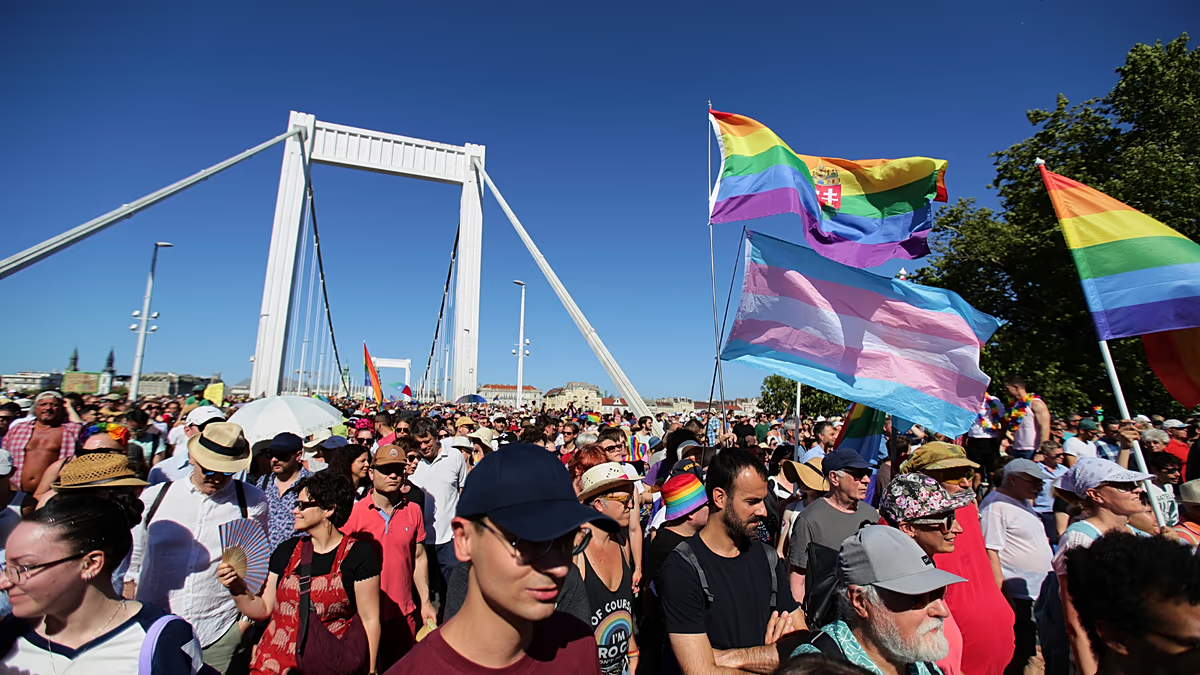
The real-world consequences of this law have been acutely felt across Hungarian society. Its reach was demonstrated starkly in 2025 when authorities invoked it to ban the Budapest Pride march, claiming the event could harm minors. This attempt to silence visibility and assembly backfired, however, as organizers defiantly proceeded, and the march drew hundreds of thousands of participants in a powerful show of solidarity and resistance. This event highlighted the chasm between the government’s narrative and the lived reality of a significant portion of its population and their allies. The law created a chilling climate where educators, artists, and healthcare providers faced uncertainty, and where LGBTQ+ youth were denied positive representations that are vital for their development and self-acceptance. The ECJ ruling formally recognizes this tangible harm, validating the experiences of those who have argued for years that the law was less about protection and more about the political scapegoating of a minority.
This ruling places a significant legal and moral obligation on Hungary’s new political landscape. The court has ordered the immediate repeal of the law, presenting an early test for the incoming government. The decision transcends a simple legal compliance issue; it is a direct challenge to the politics of division and illiberalism that have characterized Orbán’s long tenure. For the European Union, the judgment is a robust assertion of its authority to hold member states accountable to their shared commitments to human dignity, equality, and rights. It sends an unambiguous message that appeals to “traditional values” or national sovereignty cannot serve as a blanket justification for laws that undermine the very foundations of the European project. The unanimous participation of all 27 judges in the ruling strengthens its symbolic weight, presenting a united judicial front in defence of pluralism and inclusion.
As of the ruling’s publication, the outgoing Hungarian government had issued no formal response, leaving the path forward unclear. The ECJ’s decision now sets the stage for a critical juncture in Hungary’s relationship with the EU and its own citizens. Repealing the law would be a concrete step toward healing societal divisions and aligning the nation with the broader European commitment to fundamental rights. Conversely, resistance would likely trigger further infringement procedures and deepen Hungary’s isolation within the union. Ultimately, this case is about more than a single statute; it is about whether LGBTQ+ individuals are afforded equal respect and protection under the law. The court has affirmed that in the European Union, they must be. The implementation of this ruling will reveal much about the future direction of Hungary and the resilience of the EU’s core values in the face of nationalist-populist challenges.