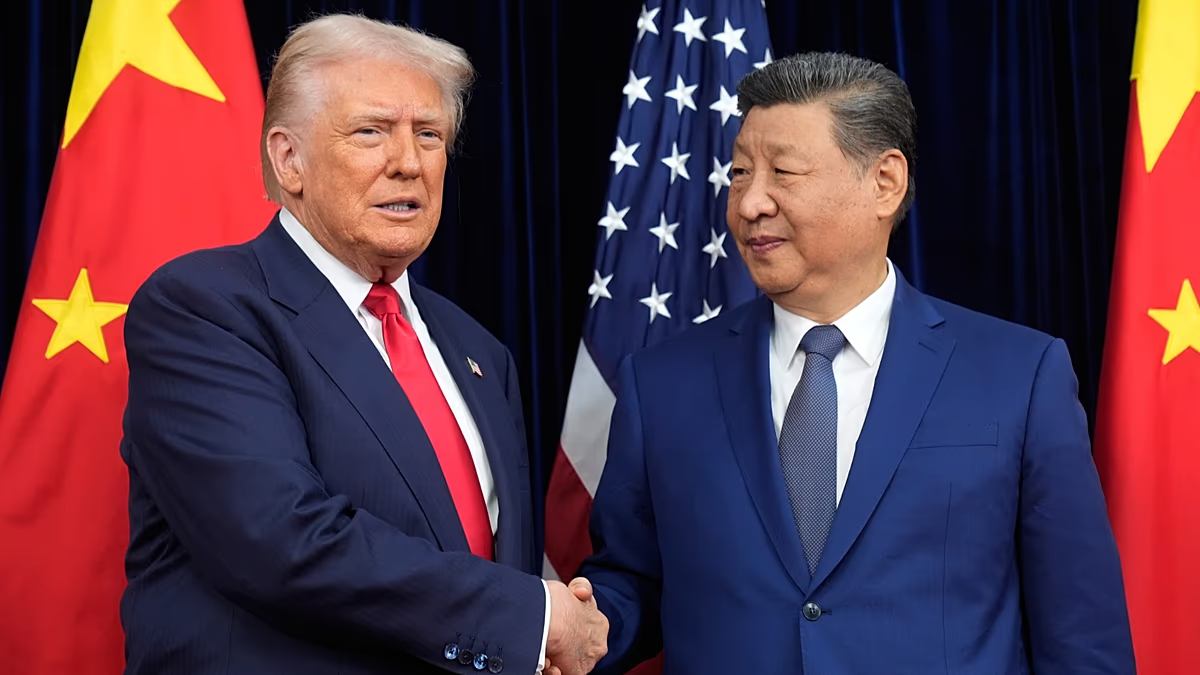


In the delicate dance of global diplomacy, where words carry the weight of nations, a familiar and discordant note has been struck once more. U.S. President Donald Trump has reignited his public criticisms of Pope Leo XIV, the first American-born pontiff, casting a shadow over a carefully planned relationship-mending visit. Secretary of State Marco Rubio, a practicing Catholic himself, is scheduled to travel to the Vatican this week, a mission now complicated by the President’s latest remarks. This recurring tension between the spiritual authority of the Holy See and the political power of the American presidency reveals a fundamental clash of worldviews, where matters of faith, statecraft, and human dignity collide on the world stage. The timing of the criticism, just before a diplomatic overture, suggests either a deliberate strategy or a profound indifference to the nuances of international rapport, turning a simple visit into a test of diplomatic endurance and theological interpretation.
The core of President Trump’s grievance, aired in an interview with conservative commentator Hugh Hewitt, centers on the Pope’s stance regarding Iran and immigration. Trump accused Pope Leo XIV of endangering people by supposedly suggesting “it’s OK for Iran to have a nuclear weapon” and by making the world “less safe” with his teachings on the respectful treatment of immigrants. These charges, however, are a significant distortion of the Pope’s actual positions. The pontiff has never advocated for Iranian nuclear armament; rather, he has consistently called for peaceful dialogue and condemned the specter of war, including Trump’s own past threats of disproportionate military strikes. On immigration, his comments are rooted in a longstanding Catholic social doctrine that emphasizes the inherent dignity of every person, a principle he frames not as political commentary but as a Gospel obligation. Trump’s framing reduces a complex theological and ethical stance to a simplistic matter of national security, revealing a deep disconnect in how the two leaders perceive their roles and responsibilities.
Pope Leo XIV’s response was a study in calm clarification, underscoring the misrepresentation while reaffirming his moral foundations. Addressing reporters, he pointedly noted the Catholic Church’s decades-long, consistent teaching against all nuclear weapons, leaving “no doubt” about his opposition to their proliferation. He doubled down on his calls for peace in the context of the U.S.-Israeli tensions with Iran, insisting his voice is not that of a political rival but of a pastor drawing from biblical inspiration. “The mission of the church is to preach the Gospel, to preach peace,” he stated, adding, “If someone wants to criticise me for announcing the Gospel, let him do it with the truth.” This distinction is crucial: the Pope situates himself within a 2,000-year tradition of moral witness, while Trump engages him as a contemporary geopolitical player. The exchange is less a debate over policy specifics and more a struggle over who gets to define reality and what voices are deemed legitimate in discussions of war and peace.
The rift has spilled beyond the bilateral U.S.-Vatican relationship, pulling a key European ally into the fray and highlighting Trump’s broader frustrations with NATO. Italian Prime Minister Giorgia Meloni, a longstanding Trump ally, took exception to his comments about the Pope. This, in turn, prompted Trump to direct his ire toward her, as part of his expanding criticisms of NATO allies he perceives as insufficiently supportive of American war efforts—a sentiment recently manifested in plans to withdraw thousands of U.S. troops from Germany. Italy’s Foreign Minister, Antonio Tajani, publicly rebuked Trump’s comments as “neither acceptable nor helpful to the cause of peace,” and strongly reaffirmed the Italian government’s support for the Pope’s message of dialogue and human dignity. This creates a delicate tightrope for Secretary Rubio, who must now navigate not only a sensitive Vatican audience but also meetings with Meloni and Tajani in Rome, all while representing an administration that has just offended his hosts’ deeply held spiritual and cultural sensibilities.
Secretary Rubio’s personal faith adds a layer of profound complexity to his diplomatic mission. As a practicing Catholic, he is tasked with bridging the chasm between his President’s abrasive secular realpolitik and the teachings of his own Church. In his own defense of Trump’s stance, Rubio attempted to reframe the criticism, arguing it was rooted in a legitimate opposition to Iran potentially obtaining a weapon that could threaten millions of Catholics and Christians worldwide. This argument seeks to ground the administration’s position in a shared concern for the faithful, attempting to find theological common ground where the President saw only political weakness. Rubio’s challenge is to perform a high-wire act of allegiance: demonstrating loyalty to the President he serves while engaging authentically with a spiritual leader whose teachings he presumably respects, all in a setting where his personal convictions cannot be separated from his professional duty.
This ongoing saga between President Trump and Pope Leo XIV is more than a personal feud; it is a symbolic collision of two powerful models of leadership. Trump’s approach, characterized by transactional relationships, nationalist priorities, and a preference for forceful dominance, sees the Pope’s moral suasion as impractical at best and dangerous at worst. Pope Leo XIV’s approach, drawn from a tradition that views peace as a built through justice and dialogue, and every human life as sacred, perceives Trump’s rhetoric as a threat to the very fabric of a humane world order. As Secretary Rubio undertakes his visit, his success will not be measured by a signed agreement, but by whether he can foster a moment of respectful pause in this clash of civilizations. In a world weary of conflict, the quiet, persistent voice calling for peace based on human dignity continues to challenge the louder voices of power, proving that some tensions are not merely political, but profoundly human.