


The state of global press freedom has reached a dire milestone, sinking to its lowest point in a quarter-century according to the latest analysis from Reporters Without Borders (RSF). Their 2026 World Press Freedom Index reveals a profoundly concerning landscape: for the first time in the report’s 25-year history, more than half of the world’s countries now exist in an environment deemed either “difficult” or “very serious” for journalists. This represents a stark reversal from 2002, when such challenging conditions affected less than 14% of nations. Perhaps most telling is the collapse in the number of people living with a “good” press environment, which has plummeted from 20% of the global population to a mere sliver—less than 1%. That small haven is now almost exclusively confined to a handful of nations in Northern Europe, with Norway consistently at the helm. This data paints a clear picture of a fundamental democratic pillar being eroded on a worldwide scale.
While Europe, bolstered by the recent European Media Freedom Act, maintains the top positions in the rankings, the report cautions against complacency. Notably, even within the European Union, several countries, including Germany, are cited for failing to fully align their national security laws with the Act’s stringent protections for journalists and their confidential sources. The war in Ukraine presents a complex case; remarkably, the country improved its ranking by seven places to 55th, a testament to the resilience of its media under the extreme duress of Russia’s invasion. However, this stands in stark contrast to the oppressive model next door. Russia, ranked 172nd, is identified as a specialist in weaponizing legislation against terrorism and extremism to silence independent journalism, with 48 journalists imprisoned as of April 2026. This eastern European dichotomy highlights how political will, even amidst conflict, can either defend or destroy press freedoms.
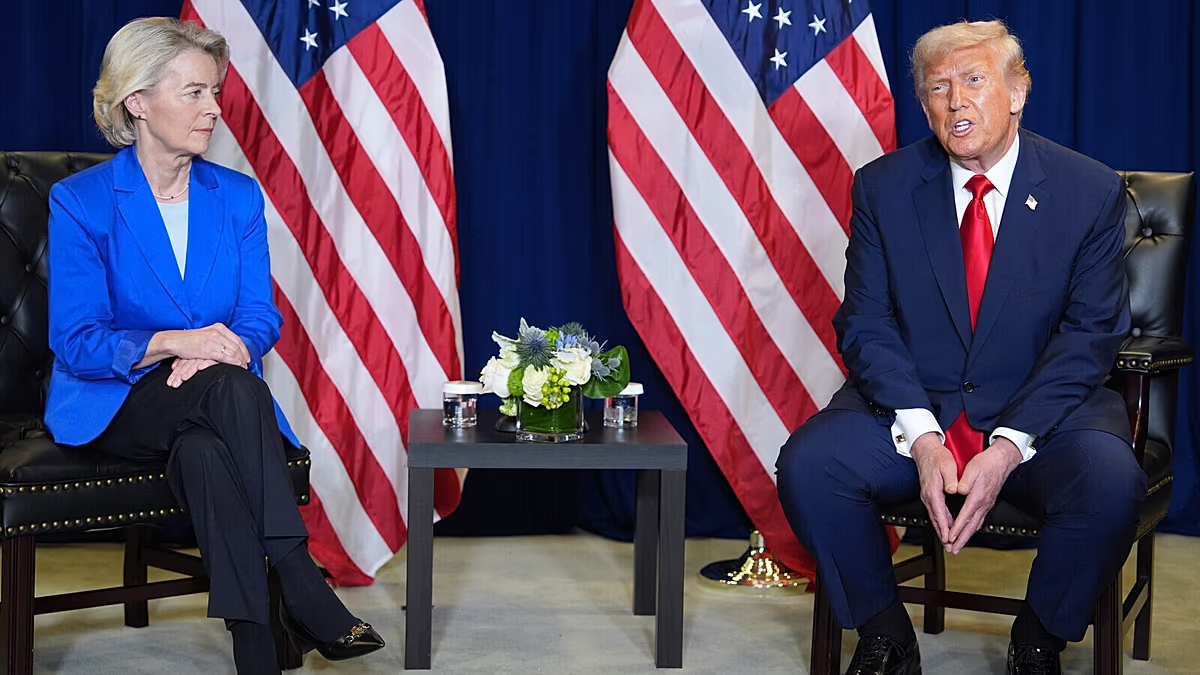
The decline is not confined to authoritarian states. One of the most significant drops noted is that of the United States, which fell seven places to 64th globally. RSF directly attributes this backslide to the “systematic policy” of then-President Donald Trump, whose tenure was marked by sustained public vilification of the press. This rhetoric, the report argues, created a toxic environment compounded by the apparent targeting of journalists and severe cuts to funding for international broadcasting networks like Voice of America. This weakening of the U.S. position is symbolically powerful, suggesting that even long-established democracies are not immune to backsliding when foundational norms, including respect for a free press, are undermined by political leadership.
Nowhere is the crisis more acute than in the Middle East and North Africa, described by RSF as the most catastrophic region for journalism. The devastating human cost is embodied in the Gaza conflict, where 220 Palestinian journalists were killed, at least 70 of them targeted because of their profession. This tragedy underscores how journalism itself has become lethally dangerous in conflict zones. The regional data is bleak: 18 out of 19 countries in the area are classified in the two worst categories. A flicker of progress was noted in Syria, which saw a historic 36-place improvement following the fall of Bashar al-Assad’s regime, though its situation remains classified as “very serious.” This indicates that while political change can create rapid improvements, the legacy of repression casts a long shadow.
Another alarming trend is the rapid deterioration in the Sahel region of Africa, exemplified by Niger, which experienced the Index’s steepest single fall in 2026. Under junta rule, the country plummeted 37 places to 120th, as military regimes and the threat from armed groups have collaborated to suppress dissenting voices and strangle the right to report freely. This pattern across West Africa illustrates how coups d’état frequently bring an immediate and severe crackdown on media independence, reversing years of progress and isolating populations from reliable information.
In conclusion, the 2026 Index delivers a sobering message: the global ecosystem for a free press is under sustained and growing assault. The threats are multifaceted, ranging from lethal violence in war zones and sophisticated legal persecution in authoritarian states to corrosive political rhetoric in democracies and regressive military rule. The fact that the average global score has never been lower signals a collective failure to protect the journalists who serve as society’s watchdogs. When over half of humanity lives in countries where reporting the news is a “difficult” or “very serious” undertaking, the very ideal of an informed global citizenry is in peril. The data is a call to action—not just for governments and international bodies, but for everyone who values truth and accountability—to defend the space for independent journalism wherever it is threatened.