


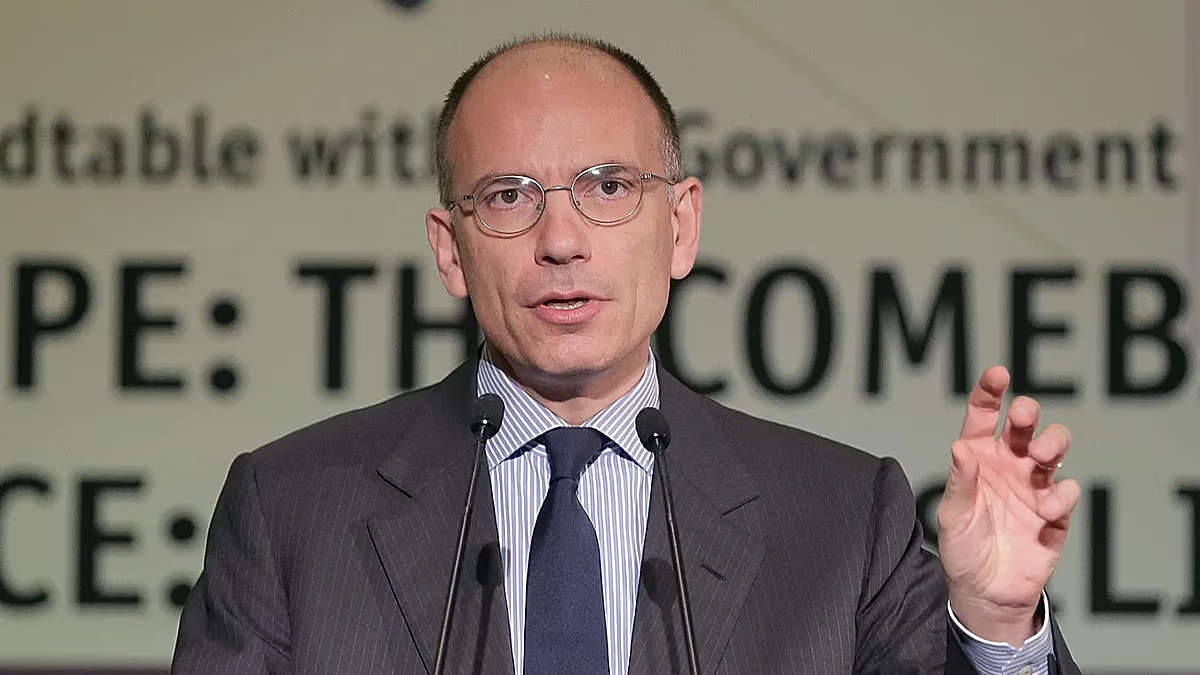
In a recent interview with Euronews, former Italian Prime Minister Enrico Letta issued a powerful and urgent call to action for Europe, framing the continent’s future as a stark choice between strategic autonomy and subservience to global superpowers. With a tone of both warning and ambition, Letta argued that Europe must rapidly accelerate the integration of its single market and forge a robust, unified industrial strategy. His central message is one of self-determination: “We don’t want to be a colony of the US, and we don’t want to be a colony of China, we want to be Europeans.” This statement cuts to the heart of a growing anxiety across the continent, where geopolitical shifts and economic pressures have exposed Europe’s vulnerabilities and fragmented responses. Letta’s vision is not merely about economic efficiency; it is a foundational project for preserving European sovereignty, influence, and a unique way of life in an increasingly polarized world.
Letta’s arguments are grounded in a concrete blueprint he authored, the influential 2024 report titled “Much More Than a Market.” This document, which has inspired the European Commission’s current agenda, moves beyond seeing the single market as just a zone of free trade in goods. It advocates for deep integration in critical sectors that are currently fragmented along national lines. Key proposals include creating a true European Energy Union to ensure security and affordability, integrating digital services to allow companies to scale seamlessly across borders, and finally unifying the continent’s splintered capital markets to pool financial resources for major investments. Most innovatively, Letta proposes a “fifth freedom”—beyond the existing freedoms of movement for goods, services, capital, and people—dedicated to research and innovation. This aims to place the knowledge economy at the very top of the EU’s agenda, recognizing that future competitiveness will be won in laboratories, universities, and tech startups, not just on factory floors.
Remarkably, Letta points to an unexpected catalyst for this newfound European urgency: the unpredictable nature of global politics, exemplified by former U.S. President Donald Trump. He notes that while the intellectual case for integration has long existed, the political will to act decisively was often lacking. However, the prospect of a “Trump II era,” with its threats of trade wars and transactional foreign policy, began to concentrate minds. A seemingly outlandish event—Trump’s past musings about purchasing Greenland—served as what Letta calls a “big wake-up call.” This episode symbolized a stark reality: even the closest of allies could view Europe’s assets and territories as commodities. The shock of this moment, combined with ongoing wars on Europe’s doorstep, shattered any remaining complacency, creating a rare consensus among European leaders that incrementalism is a luxury they can no longer afford.
Responding to this imperative, the European Commission has launched the “One Europe, One Market” strategy, a direct descendant of Letta’s work. This is not a vague declaration of intent but a detailed action plan featuring 42 specific EU-level reforms, each with its own deadline, most of which are targeted for completion within two years. The strategy aims to translate high-level ideas into tangible legislation that can boost European competitiveness on the global stage. Two pillars are particularly crucial: the creation of a strong, coherent European Industrial Strategy under an “Industrial Accelerator Act,” and the establishment of a “28th Regime” or “EU Inc.” This latter proposal would allow companies to operate under a single, streamlined set of EU rules rather than navigating 27 different national legal systems, dramatically reducing the red tape that stifles entrepreneurship and cross-border business.
The objective is clear: to approve these core legislative pillars by the end of the year, creating a framework where European companies can achieve the scale needed to compete with giants from America and Asia. This is about more than economics; it is about building a resilient base for strategic autonomy. A unified energy market protects citizens from price shocks and political coercion. Integrated capital markets can finance the green and digital transitions from within. A single rulebook for companies fosters innovation and job creation across the continent. As Letta summarizes, these are the “fundamental aspects today to make Europeans aware that we have an opportunity to be more united and more autonomous.” The project is ultimately about empowerment, giving the EU the tools to shape its own destiny rather than reacting to the agendas of others.
In conclusion, Enrico Letta’s message synthesizes a pressing geopolitical warning with a constructive, detailed pathway forward. He articulates a Europe at a crossroads, where the dangers of fragmentation and dependence are palpable, but the opportunity for unity and self-reliance is within grasp. The momentum he describes—sparked by external shocks and now channeled into a concrete legislative agenda—represents a pivotal moment for the European project. It moves the single market from a technical, often overlooked achievement into the forefront of Europe’s quest for sovereignty. The success of this accelerated roadmap will determine whether the European Union can transition from being a regulatory superpower to an industrial and innovative one, securing its place as a confident, cohesive actor capable of defending its interests and values on the world stage.